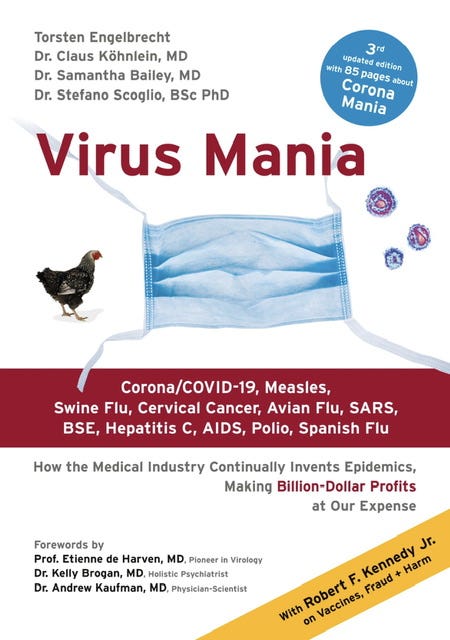
由于它的重要性,我决定冒着侵权的危险,全文转发 Etienne de Harven 教授为《Virus Mania》一书写的前言(英文原版)。希望大家能理解他在说什么。
这本书破解了历史上几乎所有的重大“疫情”(看封面),发现它们全都不是病毒传染导致的,而是有毒化学物质导致的集体中毒现象。这与我对“新冠疫情”的观察相符合,只不过书中认为化学物质中毒是“巧合”和“错误”,而我认为这些是有预谋有计划的故意放毒。
有兴趣的人可以购买这本书看看。不过警告是,它的内容非常的学术和细节,引用了 1400 多篇医学论文和书籍。没有基础的人可能需要一定的耐心和搜索才能理解。
Foreword I
by Prof. Dr. Etienne de Harven, MD
This Book Has To Be Read, Quickly and Worldwide
The book "Virus Mania" presents a tragic message that will, hopefully, contribute to the re-insertion of ethical values in the conduct of virus research, public health policies, media reporting, and activities of the pharmaceutical companies. When American journalist Celia Farber courageously published, in Harper's Magazine (March 2006) the article "Out of control--AIDS and the corruption of medical science," some readers probably attempted to reassure themselves that this "corruption" was an isolated case. This is very far from the truth as documented so well in this book. It is only the tip of the iceberg. Corruption of research is a widespread phenomenon found in many major, supposedly contagious health problems.
Scientific research on viruses (or prions in the case of BSE) slipped onto the wrong track following basically the same systematic pathway which always includes several key steps: inventing the risk of a disastrous epidemic, incriminating an elusive pathogen, ignoring alternative toxic causes, manipulating epidemiology with non-verifiable numbers to maximize the false perception of an imminent catastrophe, and promising salvation with vaccines. This guarantees large financial returns. But how is it possible to achieve all of this? Simply by relying on the most powerful activator of human decision making process, i.e. FEAR!
We are not witnessing viral epidemics; we are witnessing epidemics of fear. And both the media and the Big Pharma carry most of the responsibility for amplifying fears, fears that happen, incidentally, to always ignite fantastically profitable business. Research hypotheses covering these areas of virus research are practically never scientifically verified with appropriate controls. Instead, they are established by "consensus." This is then rapidly reshaped into a dogma, efficiently perpetuated in a quasi-religious manner by the media, including ensuring that research funding is restricted to projects supporting the dogma, excluding research into alternative hypotheses. A key tool to keep dissenting voices out of the debate is censorship at various levels ranging from the popular media to scientific publications.
Transposing the principles of bacterial infections to viruses was, of course, very tempting but should not have been done without giving parallel attention to the innumerable risk factors in our toxic environment; to the toxicity of many drugs, and to some nutritional deficiencies. Cancer research had similar problems. The hypothesis that cancer might be caused by viruses was formulated in 1903, but it has never been convincingly demonstrated. Most of the experimental laboratory studies by virus-hunters have been based on the use of inbred mice, inbred implying a totally unnatural genetic background. Were these mice appropriate models for the study of human cancer? (we are far from being inbred!) True, these mice made possible the isolation and purification of "RNA tumor viruses," later renamed "retroviruses" and well characterized by electron microscopy. But are these viral particles simply associated with the murine tumors, or are they truly the culprit of malignant transformation? Are these particles real exogenous infective particles, or endogenous defective viruses hidden in our chromosomes? The question is still debatable. What is certain is that viral particles similar to those readily recognized in cancerous and leukemic mice have never been seen nor isolated in human cancers. Of mice and men.
However, by the time this became clear, in the late 1960s, viral oncology had achieved a dogmatic, quasi-religious status. If viral particles cannot be seen by electron microscopy in human cancers, the problem was with electron microscopy, not with the dogma of viral oncology! This was the time molecular biology was taking a totally dominant posture in viral research. "Molecular markers" for retroviruses were therefore invented (reverse transcriptase for example) and substituted most conveniently for the absent viral particles, hopefully salvaging the central dogma of viral oncology. This permitted the viral hypothesis to survive for another ten years, until the late 1970s, with the help of increasingly generous sup. port from funding agencies and from pharmaceutical companies. However by 1980 the failure of this line of research was becoming embarrassingly evident, and the closing of some viral oncology laboratories would have been inevitable, except that.. Except what? Virus cancer research would have crashed to a halt except that, in 1981, five cases of severe immune deficiencies were described by a Los Angeles physician, all among homosexual men who were also all sniffing amyl nitrite, were all abusing other drugs, abusing antibiotics, and probably suffering from malnutrition and STDs (sexually transmitted diseases). It would have been logical to hypothesize that these severe cases of immune deficiency had multiple toxic origins. This would have amounted to incrimination of these patients' life-style. Unfortunately, such discrimination was, politically, totally unacceptable. Therefore, another hypothesis had to be found-these patients were suffering from a contagious disease caused by a new ... retrovirus! Scientific data in support of this hypothesis was and, amazingly enough, still is totally missing. That did not matter, and instantaneous and passionate interest of cancer virus researchers and institutions erupted immediately. This was salvation for the viral laboratories where AIDS now became, almost overnight, the main focus of research. It generated huge financial support from Big Pharma, more budget for the CDC and NIH, and nobody had to worry about the lifestyle of the patients who became at once the innocent victims of this horrible virus, soon labeled as HIV.
Nevertheless, the HIV/AIDS hypothesis has totally failed to achieve major goals. No AIDS cure has ever been found; no verifiable epidemiological predictions have ever been made; and no HIV vaccine has ever been successfully prepared. Instead, highly toxic (but not curative) drugs have been most irresponsibly used, with frequent, lethal side effects. Yet not a single HIV particle has ever been observed by electron microscopy in the blood of patients supposedly having a high viral load! So what? All the most important newspapers and magazines have displayed attractive computerized, colorful images of HIV that all originate from laboratory cell cultures, but never from even a single AIDS patient. Despite this stunning omission the HIV / AIDS dogma is still solidly entrenched… Yes, HIV/AIDS is emblematic of the corruption of virus research that is remarkably and tragically documented in this book. Whenever we try to understand how some highly questionable therapeutic policies have been recommended at the highest levels of public health authorities (WHO, CDC, RKI etc.), we frequently discover either embarrassing conflicts of interests, or the lack of essential control experiments, and always the strict rejection of any open debate with authoritative scientists presenting dissident views of the pathological processes. Virus mania is a social disease of our highly developed society. To cure it will require conquering fear, fear being the most deadly contagious virus, most efficiently transmitted by the media.
Errare humanum est sed diabolicum preservare ... (to err is human, but to preserve an error is diabolic).
Prof. Dr. Etienne de Harven, MD, was a pioneer in virology. He was a professor of pathology at the University of Toronto and member of the Sloan Kettering Institute for Cancer Research, New York. He was a member of Thabo Mbeki's AIDS Advisory Panel of South Africa and president of Rethinking AIDS (www.rethinkaids.net). Etienne de Harven died in 2019 at the age of 82.